


A Review of “Civil-Military Fusion” by Lt Gen Raj Shukla: An AI-Geopolitics Perspective


I came across a lucrative and short book by Lt Gen Raj Shukla, who is a respected member of the Union Public Services Commission, and it tempted me to read his initial treatise of perspectives on the idea of Civil-Military Fusion.
The book, and the author's regular appearances around several forums on raising the issue of reforms in India's defence ecosystem to specifically promote entrepreneur-led research-driven innovation are appreciated, which made me curious to take a deep dive into his serious work from Indian national security apparatus angle.
The China Focus in this Book is Practical and not Reactive
The best aspect of this book is that it highlights the challenges India faces with China, and with enough critical references, and expositions - also digs deeper into some of the major talent and business-related tactical ecosystems that Chinese public institutions and public sector undertakings (in few cases, GONGOs (i.e., Government-Organized Non-Governmental Organizations)) have involved into for years and decades.

Strategic acquisitions of firms, poaching of talents, productising intellectual properties etc., are a usual common feature of Chinese private sector companies and start-ups.

However, his book does an honest effort in even giving a more detailed and first principle perspective as to how even some loss-making government entities do these strategic and tactical interventions, which is interesting. In no way the book suggests the Indian apparatus to imitate what the Chinese do, but definitely offers an introductory treatise for people to at least start discussing about the issue of Civil-Military Fusion.

The reference to the story of Zhang Shoucheng is probably one of the shocking examples of how a quantum scientist committed suicide due to assumed pressure of the Chinese state apparatus, which is helpful too. This story also shows that even if China is a controlled form of ownership-erasing meritocracy, its politburo, intelligence ecosystem and government officials still behave a little or not too much like former Soviet spies and officials under Gorbachev and Brezhnev. This story actually reminds of a brilliant movie called TETRIS, which was a classic example how the IP of a Nintendo game, TETRIS - developed by a Soviet-time Russian was protected, and how many strings were pulled in a corrupt, and control-freak bureaucracy of the USSR. So, who knows? Even China can make mistakes. I believe India should learn from these stories, and real-life examples.

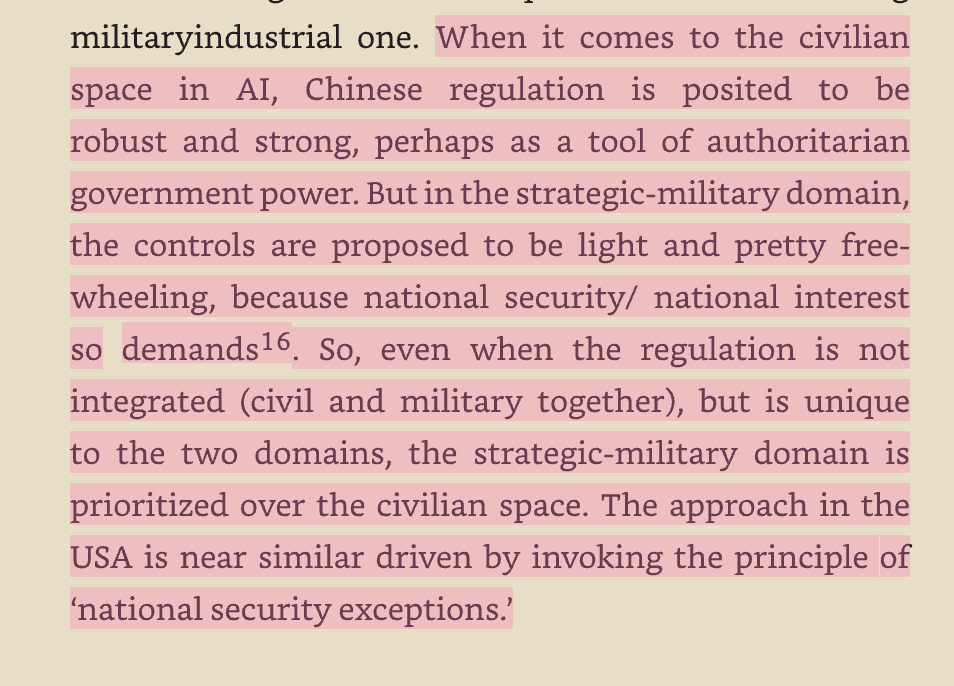
My reference to the issue that China's approach towards its civilians and business comprises of two things, i.e., state-led or state-occupied ownership and a mix of micro and macro ways to control talent and associated supply & value chains - is not merely a reflection of what the Soviets used to do, but is also a reference to a key feature of Chinese Civil-Military Fusion as described by the author in one of the pages, where he explains how Chinese regulation while has authoritarian tendencies in the civilian domain. However, it is slightly unsurprising to discover how the controls are at least "proposed" to be light and free-wheeling, even if regulation is not integrated. This does not compensate for the Soviet-style control obsession risk that the CCP or Chinese government can align towards whenever they wish to. However, this free-wheeling approach is far better than what the Russians did during the Cold war phase of human history. The US in the name of "national security exceptions" had somewhere naturalised civil-military relations in a very normalised way that even when you watch documentaries and war / spy movies, you would find that naturalised sense of wisdom and understanding on CMF. It is that visible and obvious. I would not be surprised if we see this democratised and partially open-naturalised way in Indian talent and government ecosystems.
Embracing a Resilient Approach to CMF for India and What it Explains for the Geopolitics of AI

The author has made subtle and important reference to the existing issues within the Indian defence and tech ecosystem, by directly asking a much obvious question: "how do we instil a new work ethos/ spirit [...] an ethos that is alive [...] or better still stay ahead of prospective change". He makes a reference to the dynamic Russia-Ukraine conflict which spiralled into a counterproductive situation for Moscow, and the author highlights how silos of defence ecosystems "must dissolve" with ever greater speed and momentum, referring the trifecta of Starlink, Palantir and Anduril.

While I might not much agree on the potential of large language models, since DeepSeek R1's January 2026 was done in a strategic way by the firm (i.e., DeepSeek) to crash Dow Jones in the US, considering the firm's co-founder's past stock market handling experiences. In addition, DeepSeek's GPU quantities weren't accurate, but they would not be near to what companies like OpenAI have had to build frontier models such as GPT-4 and beyond.
Nevertheless, his book definitely opens up some obvious perspectives to reflect on some realities around AI and geopolitics that one needs to understand as the situation plays out in Venezuela and Iran as of days ago.
For anyone to claim there is a US-China version of a Cold War around AI because of the trade relations between US and China around strategic challenges around the semiconductor economy - is a rather half-baked strategic assumption. It assumes the competition is over - and the book does not claim this at all. Now, on the contrary, the resource and workflow economics of AI & data are not much related to what happens to the "chip economy". Even rare earth economy doesn't matter for AI, directly. The minerals and metals economy is unique too. It can affect the electronics sector, but not necessarily the AI software economy.
In fact, even the Cold War was termed "cold" in spite of the significant loss of life among intelligence operatives, civilians, and refugees during this period. The period was characterized by diplomatic obscurity, geopolitical convolution, and layered strategic competition between the US-France-UK-West Germany bloc and the Eastern European-Soviet sphere, while much of the Global South navigated an uncertain position between these superpowers. The Chernobyl disaster and the Cuban Missile Crisis exemplify this complexity. Both incidents contained numerous tragic and intricate dimensions that become apparent upon closer examination, revealing how profoundly consequential yet geographically and psychologically distant these international crises were from everyday awareness. Thus, it makes no sense to call the US-China rivalry a "cold war".
Research (on AI & AI hype) has consistently shown how LLMs are not particularly reliable (their benchmarks have failed), and investing in data centres has a different strategic value - directly associated with data quality, ownership and largely data localisation in line with India's Data Protection Law, the DPDP Act. It has nothing to do with LLMs. At max, it benefits the data annotation and labelling proxy groups, firms and communities - but beyond that - data centre investments can reduce real estate pressure for good, which again is good for India's data sovereignty, if not (directly) AI innovation sovereignty (or a level up in all-comprehensive AI innovation).
The AI ecosystem is totally decentralised, so it is rather naive for Palantir, OpenAI or even Google to assume that they just can centralise it, and expect talent poaching and crashing stock markets (which DeepSeek did) to create a "cold war" situation. You can now create an AI solution from (say, for example) Guwahati or Lucknow, and collaborate with people in Singapore and Poland. It is a digital nomad economy.
The best part with a digital nomad economy is that when Meta, and XAI poached too much talent which was hyperfocused on large language and vision models, the talent's technical "moat" became so generic because in the name of high-end pay and "opportunities", they were being juggled across many places. Why? They just were skirting around a similar class of talent in terms of their abilities. In fact, even China can make this mistake easily, despite it recommending 60+ different AI research streams in tech conferences and otherwise.

Here is something that Scott Galloway had mentioned how China can put the US to a recession because of their giant bet on GenAI.

It is great that Indian economy is not too much interlinked to be affected by AI hype. Perhaps, the IT sector has also found out a way to surpass the risk, despite HSBC calling India an anti-AI play.
Conclusion
Understanding the geopolitics of AI requires moving beyond simplistic resource economics narratives and recognizing the interplay between rational strategic decisions and occasionally distortive political choices. This complexity can be better grasped by focusing on several core dimensions: the underlying algorithmic infrastructure, the evolutionary trajectories of various automation technologies, and the dual ethical frameworks that shape power dynamics in this domain.
These dual ethics operate on two distinct planes. First, the scientific ethics governing data outflows and algorithmic infrastructure—questions of sovereignty, localization, and technical standards. Second, the market ethics surrounding productized AI systems, services, and infrastructure—shaped by commercial incentives, competitive dynamics, and consumer protection concerns.
This distinction illuminates why regulatory approaches that burden the fundamental science of AI systems often prove ineffective, while frameworks targeting tangible, market-facing deliverables achieve greater traction. The ideological foundation of regulation matters profoundly—whether rooted in Confucian state coordination, Gandhian decentralization, Reaganite market liberalism, Putinist strategic control, or the EU's institutionalist approach exemplified by comprehensive frameworks like the AI Act.
Lt Gen Shukla's treatise on Civil-Military Fusion provides India with an essential starting point for these discussions. His practical examination of China's approach—neither reactive nor imitative—offers valuable lessons on strategic patience, ecosystem building, and avoiding the pitfalls of hype-driven investment cycles that have characterized recent AI discourse.
The decentralized nature of today's AI ecosystem, enabled by digital nomad economies and distributed collaboration, suggests that Cold War analogies fundamentally mischaracterize current US-China competition. India's opportunity lies not in mimicking either superpower's playbook, but in cultivating indigenous innovation ecosystems grounded in data sovereignty, talent development, and strategic autonomy. This requires looking beyond resource geoeconomics to appreciate the deeper aesthetic of geopolitics—how power, technology, and values intersect to shape the architecture of innovation itself.
As India navigates its defense modernisation and technological advancement, embracing this nuanced understanding of AI geopolitics becomes essential for building resilient, adaptive systems that serve national interests while contributing to global stability.


Comments